
DGHV eyes N$4.2b commercial phase …as it transitions from technical concept to bankable commercial project
DAURES – The Daures Green Hydrogen Village (DGHV) is preparing for a massive N$4.2 billion commercial expansion that could position Namibia at the forefront of Africa’s green industrialisation drive. During an onsite visit last week of the successful pilot phase, newly appointed CEO, Martin Nambundunga, shared that the green project has already secured about half... The post DGHV eyes N$4.2b commercial phase …as it transitions from technical concept to bankable commercial project appeared first
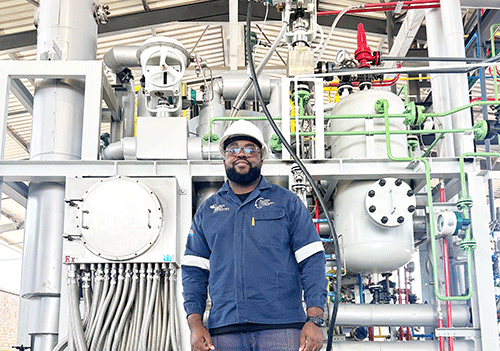
DAURES – The Daures Green Hydrogen Village (DGHV) is preparing for a massive N$4.2 billion commercial expansion that could position Namibia at the forefront of Africa’s green industrialisation drive. During an onsite visit last week of the successful pilot phase, newly appointed CEO, Martin Nambundunga, shared that the green project has already secured about half of the financing required to launch Phase 2 as it stives to bridge the gap between a technically demonstrated concept and a bankable commercial project.
Nambundunga, who is a co-founder of the project, stepped into the role in July this year after former CEO Jerome Namaseb transitioned to chairperson of the board. “Phase 2 is a reality now for this project that has been de-risked and there is quite a lot of interest in the project,” he said.
Now, after having successfully proven that hydrogen, and as a result ammonia, can be produced in the middle of nowhere using only water, wind and sun, the project situated in the Daures constituency is being positioned for a major transition from demonstration-scale production to a commercial facility capable of producing green ammonia and, ultimately, synthetic fertiliser for domestic, regional and eventually, global markets.
The much-anticipated Phase 2 expansion represents a decisive step for the project that began as a pilot initiative but is now targeting industrial-scale production, with the all-Namibian developers projecting annual production of 20 000 tonnes of green ammonia and as much as 80 000 tonnes of synthetic fertiliser per year.
According to DGHV’s July 2026 Phase 2 public presentation, the development has secured 15 000 hectares of land under a long-term lease and has access to an estimated 5GW of renewable-energy potential, supporting a much larger long-term ambition of producing up to one million tonnes of ammonia.
Project financing
DGHV’s immediate commercial phase is expected to require about US$210 million in capital expenditure, which currently works to roughly N$4.2 billion at an exchange rate of about N$20 to the US dollar.
DGHV’s developers are pursuing a funding structure combining equity, concessional finance, development finance and grant support.
According to Panashe Daringo, Managing Director of Mondjila Project Advisory & Management, who have been contracted by DGHV, a proposed financing package being pursued comprises 30% equity of about US$63 million and 70% debt of approximately US$147 million.
Among financing channels identified are Climate Investment Funds, Namibia’s proposed EIB loan facility of up to US$250 million, development finance institutions, commercial banks and grant applications involving institutions including UNIDO, the African Development Bank and the World Bank.
During last week’s site visit, Daringo noted that the project’s financing progress is significant as access to capital remains one of the biggest barriers confronting green-hydrogen developments globally.
Commercial production
The envisaged Phase 2 facility, which will be developed about 4km from the initial pilot phase, would include 60MW of solar photovoltaic generation, 10MW of wind generation and a 40MW electrolyser. It would also incorporate battery storage and desalination infrastructure to supply the water required for hydrogen production.
At full operation, Phase 2 is designed to produce about 20 000 tonnes of green ammonia annually. The ammonia plant is projected to produce approximately 2.4 tonnes per hour, based on an operating schedule of 333 days per year and 12 production hours per day.
Meanwhile, the project could have implications well beyond Namibia’s borders because more than 20 sub-Saharan African countries are net fertiliser importers, while Namibia currently imports 100% of its fertiliser. At the same time, Africa has some of the world’s lowest fertiliser application rates, contributing to poor crop yields and food insecurity.
This dependence on imported fertiliser provides the commercial rationale for Daures to move beyond green hydrogen as an energy concept and into fertiliser manufacturing.
The Phase 2 target of 80 000 tonnes of fertiliser annually would therefore create a potential domestic and regional supply source, reducing exposure to international fertiliser markets and strengthening the link between Namibia’s renewable-energy resources and agricultural production.
For Namibia, the significance is that the country can effectively use its vast solar and wind resources to turn renewables into higher-value industrial commodities rather than exporting electricity or raw energy alone.
Commercial transition
However, DGHV’s developers acknowledge that moving from Pilot phase to commercial production will not be straightforward. The project presentation identifies four major challenges, namely the green premium compared with conventional “grey” fertiliser pricing; securing suitable offtake arrangements; attracting strategic equity partners; and obtaining debt f