
SADC Summit backs industrialisation, regional integration and tourism visa
Staff Reporter PRESIDENT Netumbo Nandi-Ndaitwah has joined Southern African Development Community (SADC) leaders in endorsing a regional agenda focused on industrialisation, infrastructure development, agricultural transformation, critical minerals, regional trade and economic integration. The commitments were adopted at the 46th Ordinary Summit of SADC Heads of State and Government in Durban, South Africa, on Monday, where ... The post SADC Summit backs industrialisation, regional integration a
PRESIDENT Netumbo Nandi-Ndaitwah has joined Southern African Development Community (SADC) leaders in endorsing a regional agenda focused on industrialisation, infrastructure development, agricultural transformation, critical minerals, regional trade and economic integration.
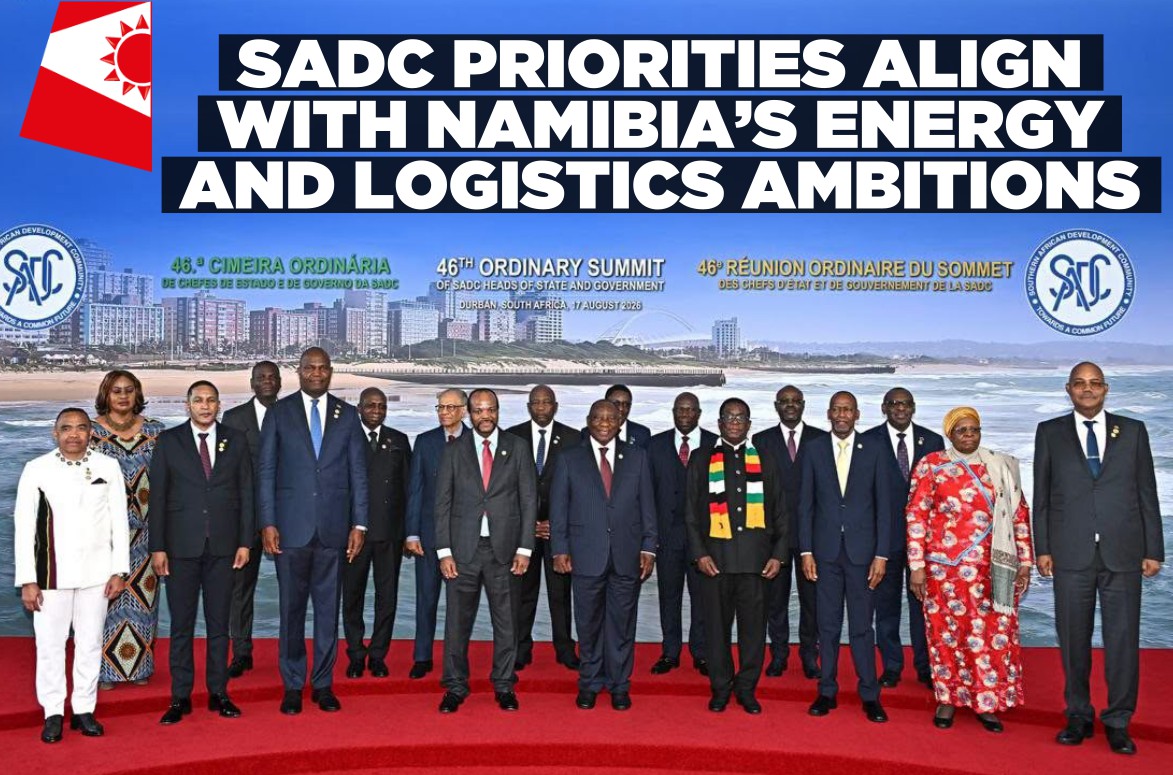
The commitments were adopted at the 46th Ordinary Summit of SADC Heads of State and Government in Durban, South Africa, on Monday, where South African President Cyril Ramaphosa was elected chairperson of the regional bloc and Zambia was selected as the incoming chair.
Nandi-Ndaitwah was among the Heads of State and Government who attended the summit, which brought together representatives from all 16 SADC member states.

The summit adopted the theme “Resilient, Sustainable, and Inclusive Industrialisation through Infrastructure Development, Agricultural and Critical Minerals Transformation in Pursuit of a Just World.”
Photos: SADC/Lesotho Government
The theme places infrastructure, agriculture and critical minerals at the centre of efforts to build a more competitive, climate-resilient and inclusive SADC region.
For Namibia, the priorities are particularly relevant given the country’s plans to expand its mining, energy, green hydrogen and emerging oil and gas industries, while strengthening regional trade and infrastructure links.
The summit’s communiqué called on member states to accelerate the implementation of high-impact priorities identified in the mid-term review of the SADC Regional Indicative Strategic Development Plan 2020–2030.
These include industrialisation, regional value chains, agro-processing, critical minerals, a just energy transition, economic corridors, one-stop border posts, resource mobilisation and health financing.
The leaders also urged member states to strengthen regional trade in agricultural products by removing non-tariff barriers, harmonising standards and improving cross-border logistics to allow food to move efficiently from surplus to deficit areas.
They further called for stronger preparedness for anticipated El Niño-induced climate shocks through early warning systems, drought preparedness, climate-smart agriculture, irrigation and drought-tolerant crops.
One of the key decisions was the approval of the agreement establishing the SADC Tourism UNIVISA, with member states called upon to sign the agreement.
The initiative is intended to facilitate easier travel across the region, boost tourism, increase visitor arrivals and investment, and strengthen regional integration.
The summit also urged member states to accede to SADC legal instruments already in force and to expedite the signing and ratification of outstanding agreements aimed at strengthening regional cooperation and harmonising economic growth.
Ramaphosa, in his closing remarks, said South Africa’s SADC chairship would place infrastructure development at the centre of its agenda, with particular emphasis on regional economic corridors.
He said the corridors should connect production centres with markets, link landlocked countries to ports and allow goods, services and people to move more efficiently and at lower cost.
The summit called for the acceleration of identified one-stop border posts and improvements to railway networks, ports, roads and logistics systems.
Energy was also identified as a key priority, with a regional target of increasing access to electricity to at least 85% by 2030.
Ramaphosa said SADC would work to strengthen electricity interconnections and accelerate investment in generation and transmission infrastructure.
Water and sanitation were similarly highlighted as priorities, with the South African president saying regional infrastructure investment should be viewed as an investment in human dignity and economic opportunity.
The focus on corridors, infrastructure and critical minerals is significant for Namibia as it seeks to position itself as a regional logistics and energy hub.
Namibia’s ports, particularly Walvis Bay, are central to regional trade routes linking landlocked countries to international markets. The country’s mining sector also places it among the SADC states with significant critical mineral and natural resource potential.
The summit’s emphasis on value addition could further support Namibia’s efforts to move beyond the export of raw materials by developing processing and manufacturing capacity.
The leaders also called for greater mobilisation of domestic and regional resources to finance the implementation of SADC’s development plans.
They welcomed progress by member states that have ratified the agreement establishing the SADC Regional Development Fund and urged those that have not yet done so to accelerate ratification so that the fund can become operational.
The fund is intended to support regional infrastructure, industrialisation and socio-economic development programmes.
The summit reaffirmed SADC’s support for efforts to restore peace and security in the Dem