

Small-scale miners call for support, regulatory reform …operators seek greater recognition as value creation contributors
KLEIN SPITZKOPPE – Abraham van Wyk and Johnny Gawanab are two young small miners eking out a living in the desolate Klein Spitzkoppe area, situated about halfway along the gravel road between Usakos and Henties Bay. The two young men were friendly and in bright spirits when New Era stopped at their roadside stall, adorned... The post Small-scale miners call for support, regulatory reform …operators seek greater recognition as value creation contributors appeared first on New Era .
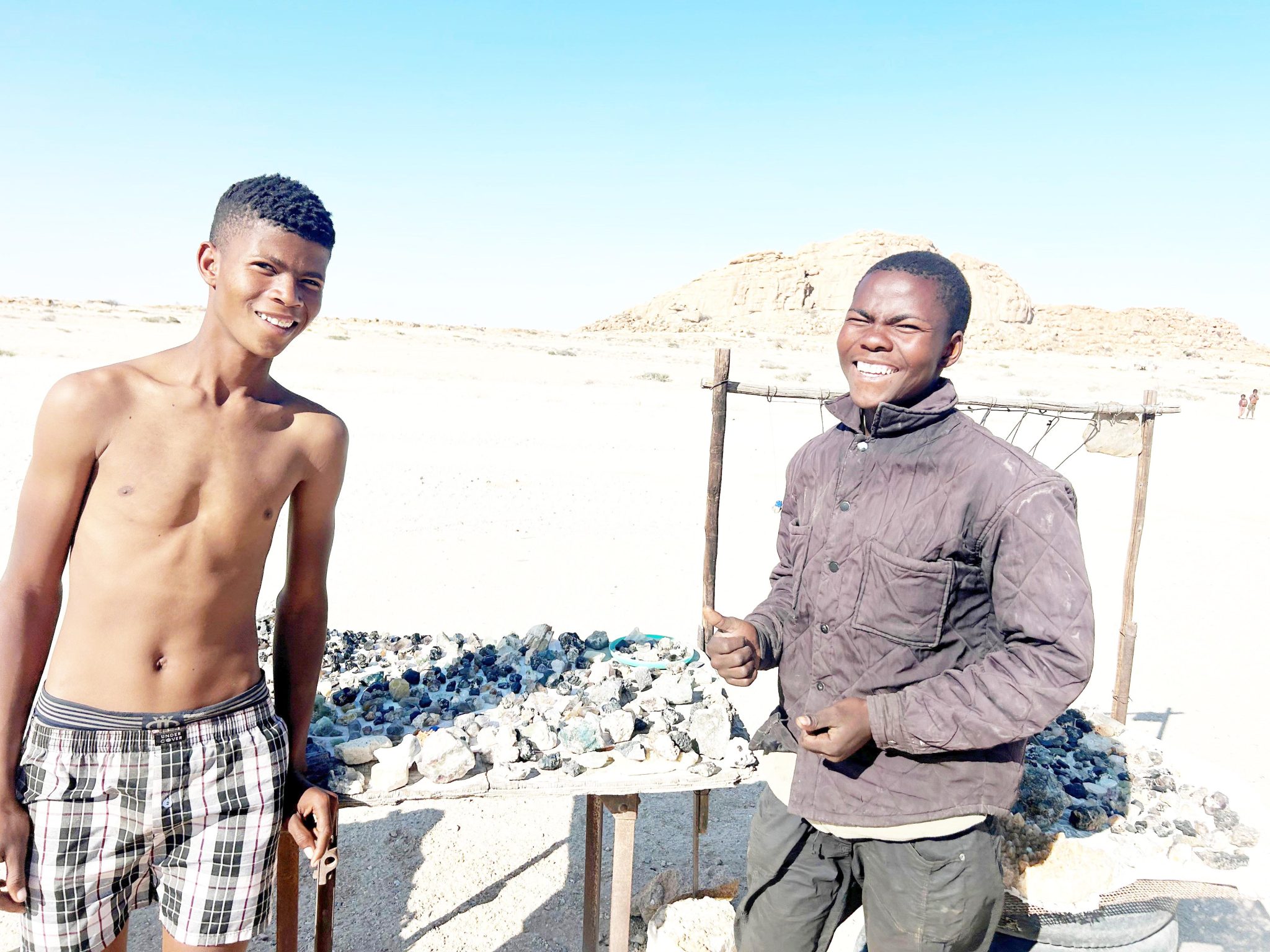
KLEIN SPITZKOPPE – Abraham van Wyk and Johnny Gawanab are two young small miners eking out a living in the desolate Klein Spitzkoppe area, situated about halfway along the gravel road between Usakos and Henties Bay.
The two young men were friendly and in bright spirits when New Era stopped at their roadside stall, adorned with rare stones, some polished and others set in metal to form part of jewellery.
The young men, who said the vast majority of their customers are tourists, explained how they mine the precious and semi-precious stones in and around the Spitzkoppe area to survive in the harsh environment.

“To access the stones, we use a hammer, chisel and wires. It is extremely labour-intensive work, which is very tiring”, said Gawanab.
Van Wyk elaborated on their modus operandi, explaining that once they feel they have enough stones, then they start selling on the side of the dusty road, hoping for generous tourists to support them.
“Some of the stones we take to Usakos for polishing, and once we sell some stones, then we get back digging for more,” said Van Wyk.
Van Wyk and Gawanab, part of Namibia’s small-scale miners, are calling for urgent government and industry intervention to unlock the economic potential of artisanal and small-scale mining, arguing that limited access to equipment, formal markets and safety training continues to constrain their ability to operate productively and safely.
The miners are also pushing for reforms to the regulatory framework governing mining claims located within Exclusive Prospecting Licence (EPL) areas, saying the current arrangements can create uncertainty and restrict opportunities for small operators to develop viable businesses.
Their concerns highlight a broader challenge facing Namibia’s mining sector: the country remains heavily dependent on large-scale mining operations for exports and government revenue, while smaller operators seek greater recognition as contributors to local economic activity, employment, and value creation.
Access to appropriate mining equipment remains one of the most immediate obstacles because most small-scale operators lack the capital to acquire machinery that can improve extraction, processing, and recovery rates. As a result, potentially productive operations remain heavily dependent on labour-intensive methods, limiting output and miners’ ability to build commercially sustainable businesses.
The small-scale miners are therefore seeking support to access affordable equipment and technical skills that would allow them to move beyond basic extraction activities and improve productivity.
Market access is another major concern as small-scale miners require reliable and transparent channels through which minerals can be sold at fair and competitive prices. Limited access to formal markets leaves operators vulnerable to middlemen and informal trading arrangements, potentially reducing the profits that ultimately reach miners and their communities.
Formal market structures could also help the government improve oversight of mineral production and trade while creating a clearer pathway for small operators to become compliant, tax-paying businesses.
Safety is equally pressing, particularly where operators work with limited equipment and technical resources, which carries significant occupational risks.
Miners are calling for improved safety training to ensure operators understand basic mining, excavation, and equipment-handling requirements. Such training would not only protect workers but could also contribute to the professionalisation of small-scale mining.
Regulatory environment
The most complex issue, however, involves mining claims situated within EPL areas. An EPL gives its holder exclusive prospecting rights over a defined area, creating potential tension where small-scale miners seek to conduct mining activities within or around areas covered by such licences.
Small miners want the regulatory framework reviewed to clarify how small-scale mining activities can coexist with prospecting rights, particularly where mineral resources are already being exploited on a small scale.
For the miners, the issue is not simply about gaining access to land. It is about creating a regulatory environment that allows legitimate small operators to participate in the mining economy without being pushed into informality.
Many small-scale miners argue that a more predictable framework could also benefit EPL holders by establishing clearer rules for engagement with small-scale miners and therefore reduce potential disputes over mineral rights.
The small-mining calls come at a time when Namibia is seeking to increase local participation in the industry to ensure the country’s mineral wealth produces broader economic benefits.
While large-scale mining projects require substantial capital and sophisticated infrastructure, small-scale mining can provide a lower-barrier entry point into the mineral economy for Namibian entrepreneurs. The