
Nam, Indonesia eye deeper cooperation
Ester Hakaala Namibia and Indonesia are seeking to deepen bilateral economic and commercial relations, with agriculture and food security, mineral value addition and energy identified as the three priority sectors for increased cooperation over the next five years. The Indonesian ambassador to Namibia Mirza Nurhidayat told New Era that the two countries have significant opportunities... The post Nam, Indonesia eye deeper cooperation appeared first on New Era .
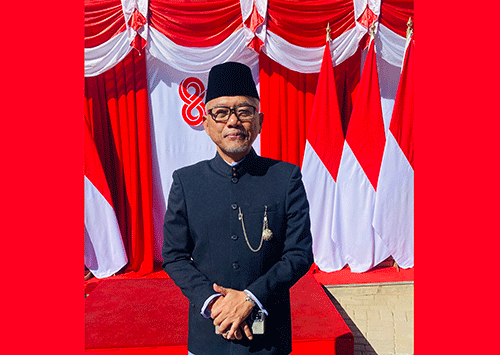
Namibia and Indonesia are seeking to deepen bilateral economic and commercial relations, with agriculture and food security, mineral value addition and energy identified as the three priority sectors for increased cooperation over the next five years.
The Indonesian ambassador to Namibia Mirza Nurhidayat told New Era that the two countries have significant opportunities to expand their existing cooperation beyond the exchange of goods and services towards long-term investments, joint ventures, technology transfer and value creation.
The ambassador said Indonesia is particularly interested in supporting Namibia’s efforts to strengthen food production, develop its mining value chains and expand its energy sector, including renewable energy and oil and gas. “Agriculture and food security; mining and mineral value addition; and energy, including renewables and oil and gas, are the three priority sectors Indonesia would like the two countries to focus on over the next five years,” he said.

The priorities, according to Nurhidayat, are closely aligned with Namibia’s economic structure and development ambitions.
Namibia’s mining sector contributes about 13.3% to the country’s gross domestic product (GDP), while the country is also targeting about 70% renewable electricity by 2030.
Nurhidayat said Indonesia could contribute to Namibia’s mining sector through its experience in mineral processing, smelting, downstream industries and the development of industrial value chains.
“Namibia’s mining sector contributes approximately 13.3% of GDP, and minerals such as uranium, diamonds, gold and copper dominate its exports, making value addition a natural area for cooperation. Indonesia can share its experience in mineral processing, smelting, downstream industries and industrial value chains to help create greater value and employment locally,” he said.
Trade growth
The two countries have already been strengthening their trade relationship, although the ambassador acknowledged that the overall level of bilateral trade remains relatively low.
According to Nurhidayat, total trade between Namibia and Indonesia increased by about 9.7% over the past five years.
Bilateral trade reached approximately US$8.2 million in 2025, while trade during January to June 2026 increased by 92.5% compared with the same period last year. The ambassador said the growth demonstrates that there is considerable room for the two countries to expand their commercial relationship.
“Currently, Indonesia and Namibia are strengthening our economic partnership, particularly in trade and investment. We are promoting Indonesian products in Namibia and creating direct business connections between companies from both countries. This shows that there is still a lot of potential to develop our trade and business cooperation, he said.
Indonesia is also encouraging its companies to explore investment opportunities in Namibia in agriculture, fisheries, manufacturing, infrastructure, renewable energy, logistics, energy and mineral downstreaming.
The ambassador said the objective is to move beyond simply trading products and establish long-term partnerships, investment and value creation between the two countries.
Status quo
Existing cooperation includes trade and economic activities such as the trade of food products, agribusiness and fast-moving consumer goods, as well as agricultural development and food security initiatives such as rice cultivation, including the Kalimbeza Rice Project, and the exchange of agribusiness technologies.
The two countries also cooperate in fisheries and marine affairs through marine product trade such as frozen mackerel supplies and vessel operational support.
Tourism and creative economy cooperation includes partnerships between travel bodies (Association of the Indonesian Tours and Travel Agencies/ASITA and Namibia Tourism Board/NTB) and cultural exchange programmes.
In the areas of defence and security, cooperation includes police capacity building, combating transnational crime and defence attaché representation.
Judicial cooperation, meanwhile, involves institutional exchanges between Indonesia’s Constitutional Court and Namibia’s Supreme Court. -ehakaala@nepc.com.na