
Shamvhura’s amputation exposes rural disability crisis …pensioner cries for wheelchair
ONGWEDIVA – At 82, Ndara Tjarura Shamvhura should be spending her later years surrounded by the family she helped raise. However, she is confined to a bed, mat or chair in her yard, dependent on her children and grandchildren for almost every basic need. Shamvhura, from Sharukwe in the Ncuncuni constituency of Kavango West, lost... The post Shamvhura’s amputation exposes rural disability crisis …pensioner cries for wheelchair appeared first on New Era .
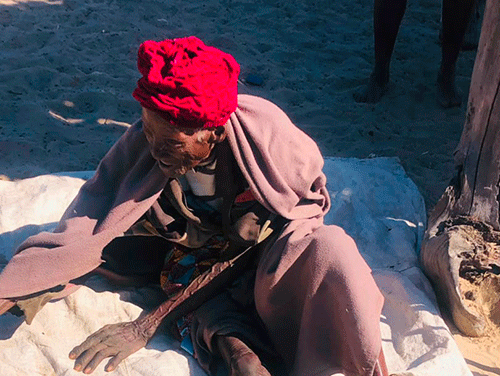
ONGWEDIVA – At 82, Ndara Tjarura Shamvhura should be spending her later years surrounded by the family she helped raise.
However, she is confined to a bed, mat or chair in her yard, dependent on her children and grandchildren for almost every basic need. Shamvhura, from Sharukwe in the Ncuncuni constituency of Kavango West, lost her leg more than two decades ago.
She now lives without a wheelchair, making even simple movements such as going to the toilet or bathing a major challenge.

Her two children are unemployed, while 14 grandchildren live at the homestead.
With no stable income, the family relies on informal work, small-scale selling and assistance from neighbours to survive while also providing full-time care for the elderly woman. Her granddaughter, 32-year-old Cecilia Muloyi, remembers how Shamvhura’s ordeal began in 2002.
“In 2002, my grandmother got sick, and that is how she lost her leg. She was attending a funeral service for someone who had died in the village, and she wanted to go and get her jacket. When she reached the road, she felt like something hit her on the leg. She came back home and decided not to return to the funeral,” Muloyi recalled.
That night, Shamvhura experienced severe pain and later collapsed.
“We called everyone and took her to a traditional healer, but the healer told us it was already too late because her leg was getting rotten. A few days later, we took her to the hospital in Rundu. When we reached the hospital, worms were already coming out of the leg. So, we had to sign for the leg to be cut off,” Muloyi said.
Amputation
Following the amputation, Shamvhura was given crutches, which helped her regain some mobility.
However, age and declining strength have now made it difficult for her to use them.
“We do not have a wheelchair, and it is getting very difficult. When she wants to bathe or go anywhere, we have to carry her or assist her,” Muloyi said. The family’s circumstances have also changed dramatically since Shamvhura lost her mobility. “Our grandmother was the one taking care of us. She used to plough and harvest. Now we are the ones ploughing with hoes because we do not have cattle. There are 14 grandchildren here, and no one in this house is employed,” Muloyi said.
She said she previously sold chips and sweets to help the family survive, but the grandchildren are now forced to take on more responsibilities. Shamvhura also continues to experience pain in her remaining leg and other health problems, according to Muloyi. “She is always sick, and her leg is always in pain. She cries because of the pain, and her tummy gets swollen whenever the leg starts to hurt. At the hospital, we did not get much help. The only help she gets now is medicine for high blood pressure,” she said.
The absence of mobility equipment has turned ordinary household activities into physically demanding tasks.
When Shamvhura needs to move, someone must lift or support her. To sit up, a grandchild helps pull her into position, while trips to the toilet or bathing area require her to be carried.
Sometimes, when no one is available to move her, she remains in the same position for hours. Healthcare is another challenge for the family. Muloyi said the clinic at Gwatjingwa, about 20 kilometres away, is difficult to access and sometimes runs short of pain medication. The family must sometimes travel further to Ncaute, where they believe medicines are more readily available, but transport costs make such trips difficult.
Official
Ncuncuni constituency councillor Michael Naiteta said his office is aware of Shamvhura’s situation and is working to secure a wheelchair for her.
“Right now, she is struggling a lot because she cannot move on her own, so we have requested a wheelchair for her and will bring it once we receive it,” Naiteta said.
He said Shamvhura’s situation reflects a broader challenge facing elderly people in rural communities, where residents with mobility difficulties often lack access to assistive devices and regular home-based support. At Shamhura’s homestead, that challenge is visible in everyday routines.
A woman who once ploughed fields and harvested food for her family now depends on her grandchildren to lift her from one place to another. Naiteta said the situation also places additional pressure on families already struggling to make ends meet.
“Grandchildren, who should be focusing on schoolwork, are instead learning how to carry an adult and shift her from one spot to another. A family already struggling with hunger is expected to provide full-time disability care without training, equipment or reliable outside help,” he said.
For Muloyi and her cousins, Shamvhura’s disability is not simply an issue discussed in policies or programmes. It is a daily reality of lifting their grandmother, helping her bathe, attending to her pain and worrying about leaving her alone while they go to the fields or search for casual work. A wheelchair, the family believes, would