

Eswatini domesticates the SADC anti-graft protocol
Moses Magadza The Kingdom of Eswatini has intensified efforts to domesticate the Southern African Development Community Protocol Against Corruption. Parliament, the Anti-Corruption Commission and other key national institutions convening a two-day engagement aimed at identifying legal, policy and institutional reforms needed to give the regional instrument full effect in the country. The National Engagement on... The post Eswatini domesticates the SADC anti-graft protocol appeared first on New
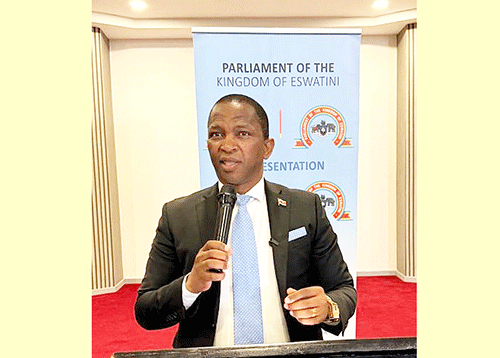
The Kingdom of Eswatini has intensified efforts to domesticate the Southern African Development Community Protocol Against Corruption.
Parliament, the Anti-Corruption Commission and other key national institutions convening a two-day engagement aimed at identifying legal, policy and institutional reforms needed to give the regional instrument full effect in the country.
The National Engagement on the Domestication of the SADC Protocol Against Corruption, which opened at Bethel Court in Ezulwini recently, assessed how far Eswatini’s existing laws and institutions align with the protocol, identify remaining gaps and develop a practical roadmap for implementation.

The engagement was co-hosted by the Parliament of the Kingdom of Eswatini and the SADC Parliamentary Forum (SADC-PF), with support from GIZ, International Partnerships Austria, the German Federal Ministry for Economic Cooperation and Development (BMZ) and the European Union.
Opening the meeting, Speaker of the House of Assembly Jabulani Clement Mabuza said the process represented an opportunity to move beyond regional commitment and examine what still needed to be done nationally to strengthen the fight against corruption.
“We are gathered not merely to discuss corruption as an abstract governance challenge but to consider the practical measures required to strengthen our national response to it,” speaker Mabuza said.
He added: “This workshop provides an opportunity to examine our laws, institutions and practices against the obligations and standards established under the SADC Protocol Against Corruption”.
He said the engagement came at a critical moment, following a call by His Majesty King Mswati III for the country to intensify the fight against corruption.
“His Majesty King Mswati III has made a clarion call for the nation to bring corruption to an end,” Mabuza said.
He added: “We must all rise to the occasion and translate that call into deliberate, coordinated and measurable action”.
The SADC Protocol Against Corruption was adopted in 2001 to promote common regional standards for preventing, detecting and punishing corruption and strengthening cooperation among Member States.
The speaker noted that Eswatini had taken an important legislative step five years later through the Prevention of Corruption Act of 2006, which established a framework for preventing, investigating and punishing corrupt conduct.
However, he said enactment of national legislation and ratification of regional instruments were only foundations and did not by themselves amount to complete domestication.
“Ratification of a regional instrument and the enactment of national legislation are important foundations, but they are not the end of the process,” he said.
He contended that “the principles of the protocol must be fully translated into effective national laws, properly resourced institutions and consistent administrative practices”.
The speaker said domestication was essential because it closed the gap between what countries had agreed to at a regional level and what their institutions were empowered and required to implement.
He called on participants to identify provisions of the protocol already adequately reflected in Eswatini’s laws, areas where legislation remained incomplete and institutional or operational barriers to effective implementation.
He said attention should be given to prevention, public-sector integrity, transparent procurement, whistleblower and witness protection, investigation and prosecution, asset recovery, access to information and cooperation among national and regional institutions.
Mabuza stressed that parliament had a central responsibility in the domestication process through its legislative, oversight and representative functions.
“Parliament occupies a central place in this process,” he said.
He added that its legislative role required it to ensure that national laws adequately criminalised corrupt conduct, protected public resources, promoted transparency and supported recovery of unlawfully acquired assets.
He, however, warned that legislation alone would not be enough.
“Parliament must exercise continuous oversight over the implementation of the law, the management of public resources and the performance of institutions entrusted with promoting integrity and accountability,” he stated.
The speaker called for the engagement to conclude with a concrete roadmap rather than broad declarations.
“The outcome of this engagement must extend beyond general declarations of commitment,” he said.
He said the roadmap should identify outstanding legislative, policy and institutional measures, specify responsible institutions, set realistic timelines and establish mechanisms for monitoring and reporting progress.
Maphevu Mkhatshwa, the ACC acting commissioner, welcomed the domestication initiative.
He described it as an important opportunity to align Eswatini’s national anti – corruption framework more closely w